I — History

Three centuries of Venetian nobility.

From the Loredan foundation to the twentieth-century restoration — a continuity rare in the Serenissima's mainland estates.

I
1688

Venetian origins

The history of the villa begins in 1688, when the patrician Giovanni Loredan started construction of the residence in the countryside of Vascon, then part of the Marca Trevigiana. The Loredan family, one of the most ancient and influential of the Republic of Venice, counted three doges among its members: Leonardo (1501–1521), Pietro (1567–1570) and Francesco (1752–1762). This illustrious lineage gives the villa an aura of nobility that still defines its identity today.

Leonardo Loredan, Bellini
Pl. ILeonardo Loredan, Bellini
II
1700–1730

The eighteenth century and the present form

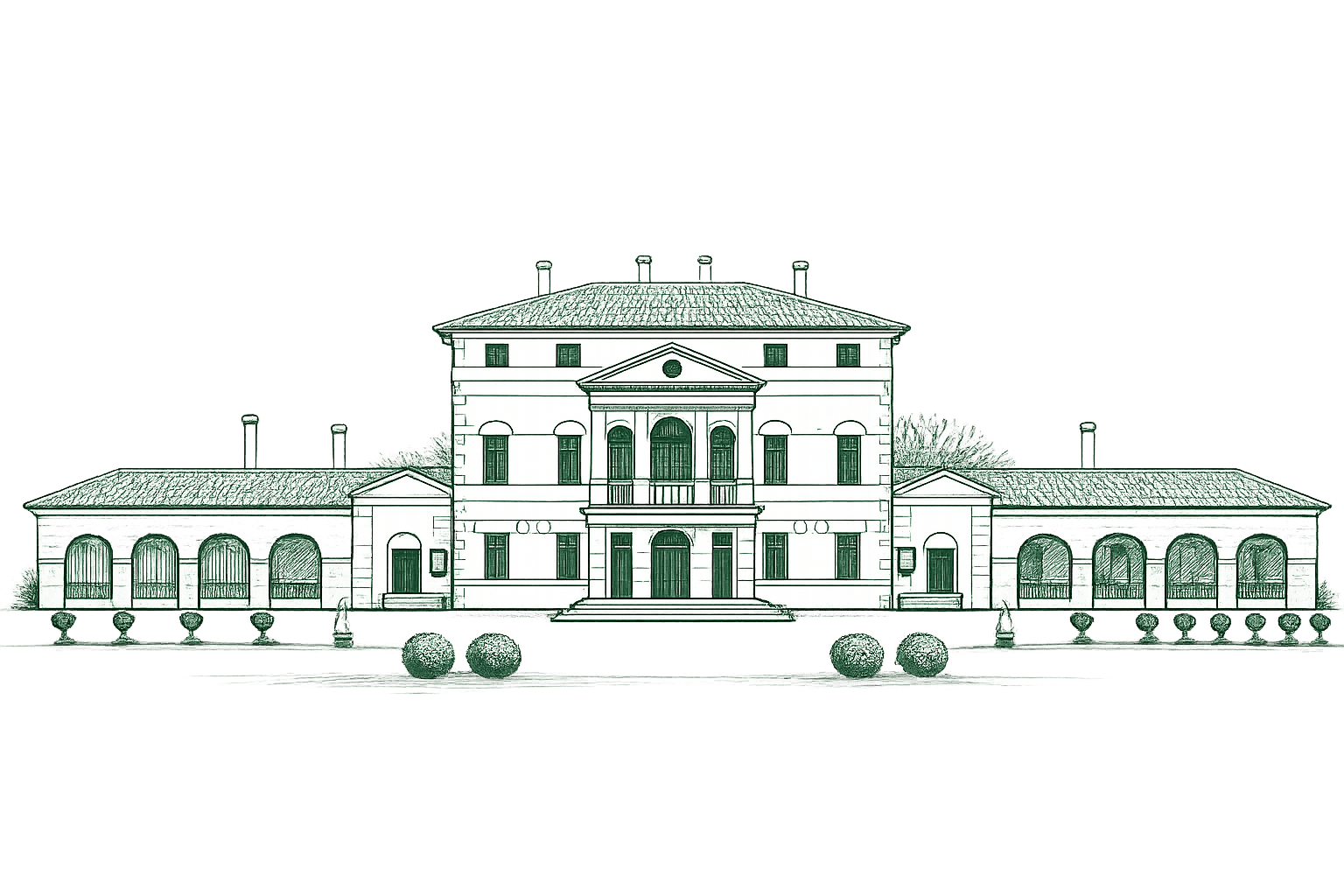
Between the late seventeenth and the first decades of the eighteenth century, the brothers Antonio and Alvise Loredan completed and enriched the complex, giving it the harmonious form we know today. The severe, well-proportioned central body is flanked by two porticoed barchesse used for the services and agricultural life of the estate. The façade is marked by an elegant Ionic pronaos with four half-columns and a triangular pediment.

III
c. 1720

The frescoed great hall

The piano nobile holds a double-height salone, frescoed entirely around 1720 by Gerolamo Brusaferro, a Venetian painter, and by Niccolò Bambini, a leading figure of lagoon painting, with quadratura painters likely from Emilia who authored the illusionistic stage settings. The cycle depicts episodes from Roman history and the Aeneid: The Rape of the Sabines, Aeneas Receives the Divine Arms, The Death of Turnus, Apollo and Flora. It is considered one of the most important examples of Baroque decoration in the Veneto.

Il salone affrescato
Pl. IIIFrescoed great hall
IV
1719

The oratory of the Madonna of Loreto

Built in 1719, the oratory has a circular plan with a triple-apsed presbytery — a unicum in the early-eighteenth-century sacred architecture of the Veneto. Its position, detached from the villa and facing the road, underlines its joint public and private function.

V
19th – 20th c.

From the Valier to the twentieth century

In the nineteenth century the villa passed to the Valier, an ancient Venetian family, who held it until 1940. After a period of decline, in the post-war years the Perocco di Meduna family undertook a major conservation restoration that returned the complex to its architectural and landscape integrity.

VI — DOGES

The three Loredan Doges

01
Leonardo Loredan
1501 – 1521
Seventy-fifth Doge of Venice, portrayed by Giovanni Bellini.
02
Pietro Loredan
1567 – 1570
Elected in a period marked by the war of Cyprus.
03
Francesco Loredan
1752 – 1762
One hundred and sixteenth Doge, the last of the family.
VII — PARK

The park and the statues

The complex is set within an intact landscape: a historic garden, a park, the brolo and the spring waters that give rise to the river Mignagola. In the park stands a rare cycle of six allegorical statues attributed to Alvise Tagliapietra, a Baroque sculptor active not only in the lagoon but also in Dalmatia and Russia. The figures depict Prudence, Fortitude, Temperance, Justice, Victorious Command and Military Valour.

  • 01Prudence
  • 02Fortitude
  • 03Temperance
  • 04Justice
  • 05Victorious Command
  • 06Military Valour
The six allegorical statues
Pl. IVThe six allegorical statues